|
|
|
|
|
 |
|
|
|
|
|
|
|
|
Italy
Cranston Military Prints  By Subject Military Art World War Two By Subject Military Art World War Two  Italy Italy |
[UP] - Anzio - Arnhem - Arras - Battle of The Bulge - Beda Fomm - Berlin - Caumont - Dieppe - Dunkirk - El Alamein - Falaise Gap - Gazala - Guadalcanal - Kowel - Kursk - Medenine - Monte Cassino - Monte Piccolo - Norway - Okinawa - Pagoda Hill - Stalingrad - Tarawa - Targul Fromos - Tobruk - Warsaw - Ardennes - Burma - D-Day - Eastern Front - Italy - Manchuria - North Africa - Pacific - Normandy - World War Two Print List |
| Italy Campaign World War Two military prints. Our collecion of prints and paintings depicting the Italy Campaign. |
|
|
|
|
|
|
|
|
|
| Text for the above items : |
The Battle of Monte Cassino by Terence Cuneo. Depicting the 8th Army artillery firing on the last Battle of Cassino, 600 guns destroyed the remaining German defences. |
Strike For Gela, Sicily, 11th June 1943 by David Pentland. Tiger I tanks of 2 Kompanie/ Schwere Panzer Abteilung 504, attached to Panzer Division Herman Goring, launch their attack on the main US 7th Army landing beach at Gela, on the first day of Operation Husky. Despite the fact that the Herman Goring troops were untried in battle it was only the devastating effect of allied naval gunfire that stopped them reaching and probably destroying the beach head. |
Anzio Annie, Italy, 29th January 1944 by David Pentland. Sturmgeschutz IIIg and Paratroops of the 4th Fallschirmjager Division, driving to the front line, pass one of the two giant 28cm K5 (Eisenbaum) railway guns responsible for the shelling the Allied beacheads at Anzio and Nettuno. |
Though I be the Lone Survivor by James Dietz. Darbys Rangers - Battle of Cisterna. 22 January, 1944, 1st, 3rd, and 4th Ranger Battalions spearhead the Anzio landing in Operation Shingle. This was one of the most effective and least costly of all Allied amphibious landings, but the least exploited. It was ten days after the landing before General Lucas ordered his forces to advance on Rome. The mission of Task Force Ranger was to use their special training for a night infiltration behind German lines to set up two major blocking positions. This would relieve the pressure on the beachhead and possibly start the 30-mile drive on to Rome. 0100, on 30 January, 1st and 3rd Ranger Battalions moved out into the night hoping to reach the town of Cisterna and its vital road junction. The terrain between the departure point and Cisterna was flat farmland with little or no cover. Stealthily moving toward the objective, 1st and 3rd Battalions continued to avoid detection. Though they passed close by German positions and enemy patrols crossed in front and on both sides, the Ranger presence seemed to go unnoticed as daylight approached. Moving in the file formation, as they had used several tines successfully before, is one of the more risky behaviors of the Ranger advance. As night gave way, the Rangers could see the town of Cisterna, only five hundred yards away. The two battalions surged forward as one trying to enter the town, and find cover before the sun and the Germans found them. As night ended so did the elements of Task Force Ranger. The single enemy machine gun that once blocked 4th Ranger Division soon became a dozen. The Germans quickly counterattacked stopping them dead in their tracks, even cutting them off as Colonel Darby urged them forward towards their brother Rangers. No Rangers, Infantry of Sherman tanks would force their way up that road that day or in 100 days. 4th Ranger Battalion bled themselves white for eight hours trying to reach 1st and 3rd Ranger Battalions, but they were left on their own. As the Rangers sprinted forward with Garands, BARs and Thompson machine guns in their hands, covering the last two hundred yards; the end of a long journey seemed near and so it was. Somewhere along the last mile the Germans detected the Ranger infiltration. The unit that got to the town first was not the Ranger, but elements of the 4th Fallschirmjaeger Regiment, the elite of the German Paratroopers. A sheet of flame and steel ripped into the Rangers in mid stride causing them to collapse in a nearby farmer's open field. Going into semi-circular defensive position, which measured 300 yards by 100 yards, the Rangers returned fire. As the Rangers, lying in the open field, devoid of cover, fired, the German Paratroopers closed in on them with heavier and heavier weapons systems. The Rangers fought bravely through that night and into the day, but without heavy organic weapons, the battle was lost as soon as they were caught in the open. In just under eight hours, the battle was over. No more shooting was heard just the moaning of the the dead and dying, and the shuffling of the captured. Only six men returned to report to Colonel Darby, only six out of the 767 that began the missions. |
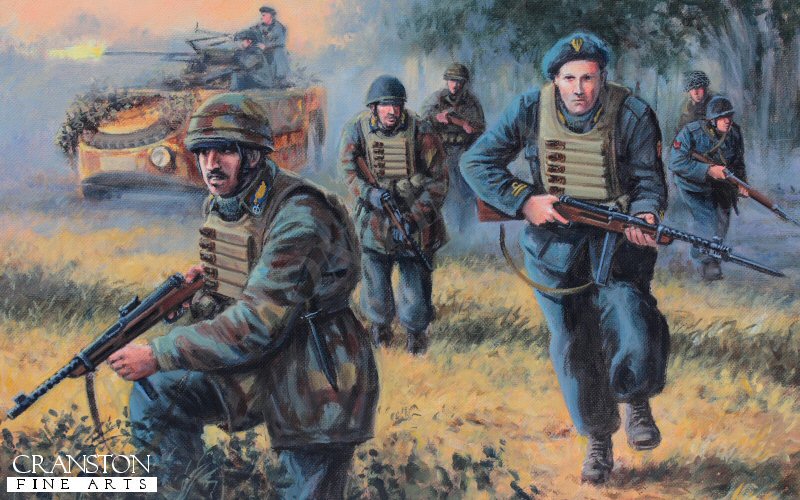
Nembo at Anzio by David Pentland. Anzio, Italy, February 1944. Italian paratroopers of the RSI Independent Nembo Parachute Battalionattached to the German 4th FJ (parachute) Div advance through early morning mists against allied positions in Anzio and Nettuno. |
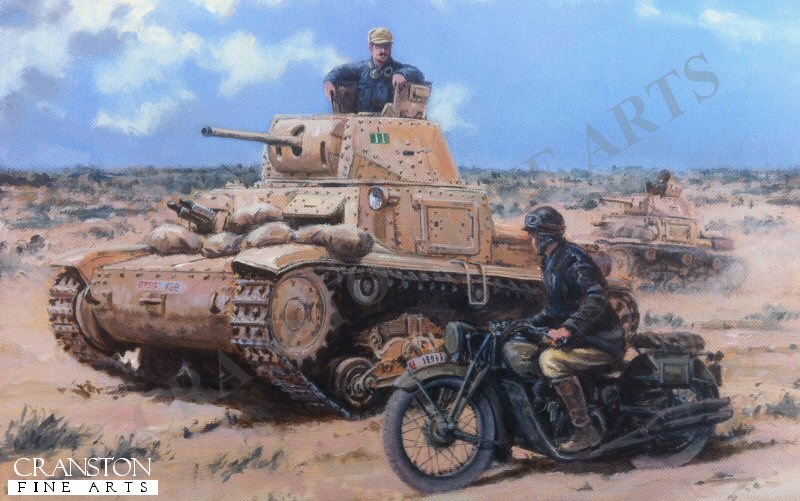
New Orders by David Pentland. July 1942. Italian M13/40 tanks of 132nd Armoured Regiment, Ariete Division stop to receive an urgent dispatch while advancing on the British defensive lines at El Alamein. |
Anzio, Italy, February 1944 by David Pentland. Replacements from 1st Battalion Irish Guards and Sherman tanks of the 46th Royal Tank Regiment move through the debris of Anzio town towards their jump-off positions for the Battle of Campoleone Station. |
Panther Stellung, Monte Cassino, Italy, 21st -22nd May 1944 by David Pentland. While commanding an emplaced Panther tank turret east of Piedimonte, the young Gefreiter Herbert Fries, from 2./FschPzJagAbt 1, slowed down the Allies who were trying to outflank what was left of 1FJD. In two days he and his crew knocked out 17 enemy tanks. |
S Company Scots Guards in the battle of Monte Piccolo, Italy 28th May 1944. by Terence Cuneo. S Company Scots Guards along with 3 Company Coldstream Guards, after heavy fighting, captures the hill from the German 1st Parachute regiment. |
|
Contact Details |
|
Sign Up To Our Newsletter!
This website is owned by Cranston Fine Arts. Torwood House, Torwoodhill Road, Rhu, Helensburgh, Scotland, G848LE Contact: Tel: (+44) (0) 1436 820269. Email: cranstonorders -at- outlook.com
|
|
|