|
|
|
|
|
 |
|
|
|
|
|
|
|
|
Sandy Johnstone
| Air Vice Marshal Sandy Johnstone CB DFC AE DL (deceased) Early in 1938, Alexander Vallance Riddell Johnstone, known as Sandy, was a civilian navigation instructor at Scottish Aviation, moving later to the Civil Air Navigation School at Prestwick. In August 1939 he was called to full-time service with 602 Squadron. After some Spitfire engagements off the Scottish coast, he received command of 602 - he was still only 24 - and led it south to the tiny airfield at West Hampnett, in West Sussex, where it was stationed throughout the Battle of Britain. Sandy was in command of no. 602 squadron during the critical days of the Battle of Britain, flying with the squadron before the war though to 1941, when he was posted to the Middle east, he also served with 229 and 249 squadrons in Malta during the Islands most fateful days of the war. Sandy became a successful author and resided near Ipswich in Suffolk. Sandy Johnstone died 13th December 2000, aged 84. |
|
|
|
|
| Text for the above items : |
Gauntlet by Anthony Saunders. Portsmouth August 26th 1940, the lone spitfire of Squadron Leader Sandy Johnstone breaks the ranks and picks off one of the menacing Heinkels only to encounter an equally determined attack from a BF109. We were brought to readiness in the middle of lunch and scrambled to intercept mixed bag of 100+ Heinkel IIIs and DO 17s approaching Portsmouth from the South. The controller did a first class job and positioned us one thousand feet above the target. with the sun behind us, allowing us to spot the raiders from a long way off. No escorting Messchersmitts were in sight at the time, although a sizable force was to turn up soon after. then something strange happened. I was about to give a ticking off to our chaps for misusing the R/T when I realised I was listening to German voices. It appeared we were both using the same frequency and, although having no knowledge of the language it sounded from the monotonous flow of the conversation that they were unaware of our presence. as soon as we dived towards the leading formation, however we were assailed immediately to loud shouts of Achtung Spitfuern Spitfuern! as our bullets began to take their toll. In spite of having taken jerry by surprise our bag was only six, with others claimed as damaged, before the remainder dived for cloud cover and turned for home. In the meantime the escorting fighters were amongst us when two of our fellows were badly shot up. Hector Maclean stopped a cannon shell on his cockpit, blowing his foot off above the ankle although, in spite of his grave injuries, he managed to fly his spitfire back to Tangmere to land with wheels retracted. Cyril Babbages aircraft was also badly damaged in the action. forcing him to abandon it and take to his parachute. He was ultimately picked up by a rescue launch and put ashore at Bognor, having suffered only minor injuries. I personally accounted for one Heinkel III in the action (Sandy Johnson) . No. 602 City of Glasgow auxiliary squadron was a household name long before WWII began. It had been the first auxiliary squadron to get into the air in 1925, two of its members, Lord Clydeside and David McIntyre were the first to fly over Mount Everest in 1933: the squadron sweeped the board in gunnery and bombing in 1935, beating the regular squadrons at their own game. It was the first auxiliary Squadron to be equipped with Spitfire Fighters as far back as March 1939 and it was the first squadron to shoot down the first enemy aircraft on British soil. The squadron moved south from Drem airfield in East Lothian on August 14th 1940 to relieve the already battered no. 145 squadron at Westhampnett, Tangmeres satelitte station in Sussex. The squadron suffered 5 casualties during the battle. The squadron remained at Westhampnett until December 1940 to be replaced by no. 610 auxiliary airforce squadron. No 602 squadron itself remained active up until 1957 when it was put into mothballs. |
Head to Head by Nicolas Trudgian A classic head-to-head combat between Squadron Leader Sandy Johnstone in his Spitfire and an Me109 over the south coast of England on 25th August, 1940. With 602 Squadron scrambled to intercept an approaching raid. The Commanding Officer notches up his second victory of the day. Published 2000. |
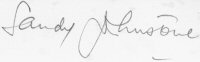
Clipped Signature - Sandy Johnstone. Flew Spitfires in command of No.602 Sqn during the Battle of Britain before serving in the Middle East and then in Malta with No.229 Sqn and No.249 Sqn. A successful author after the war, he died in 2000 aged 84. |
Fight for the Sky by Robert Taylor. All through the long hot summer of 1940 they crossed the Channel from stolen bases in northern France, coming in mighty swarms to deliver their deadly cargo. Bombers and dive-bombers, single-seat fighters and fast twin-engined attack aircraft, their menacing shapes glinting with swastikas and black crosses, blackening the summer sky. Over 3000 aircraft were at the disposal of the boastful Luftwaffe supremo, Hermann Goering. Within just a matter of weeks, he promised Hitler, the RAF would be annihilated, allowing the invasion of Britain to proceed unhindered, and Britain would become the final piece of the jigsaw giving Nazi domination throughout Europe. Against the might of German airpower stood less than 600 Spitfire and Hurricane fighters, and as many young pilots determined to the man to defend their homeland. And so commenced the battle that was to develop into the greatest aerial conflict in history. Always outnumbered, often flying six sorties a day, the RAF's young fighter boys flew themselves to the point of exhaustion. Pilot losses forced desperate squadron commanders to take youngsters into combat, some with just a few hours on fighters. They flew and fought like tigers and they paid a heavy price, but never did they lose their spirit. Robert Taylor's wonderfully realistic painting captures the very essence of that epic battle. A Heinkel 111 has been brought down, one of many never to make it home on this bright and sunny day. As the Luftwaffe bomber's crew emerge from their broken aircraft, relieved to have survived the crash-landing, a Mk I Spitfire from No.66 Squadron roars low overhead to verify another victory. In the distance, Hurricanes from No 56 Squadron hurry back to North Weald to refuel and rearm. High above the battle rages, the vapour trails telling their own story. |
|
Contact Details |
|
Sign Up To Our Newsletter!
This website is owned by Cranston Fine Arts. Torwood House, Torwoodhill Road, Rhu, Helensburgh, Scotland, G848LE Contact: Tel: (+44) (0) 1436 820269. Email: cranstonorders -at- outlook.com
|
|
|