|
|
|
|
|
 |
|
|
|
|
|
|
|
|
Steve Pisanos
| Colonel Steve Pisanos (deceased) Born Nov. 10, 1919, in the Athens suburb of Kolonos, Spiros Nicholas 'Steve' Pisanos, the son of a subway motorman, arrived in America in April 1938 as a crew member on a Greek merchant tramp steamer. Arriving in Baltimore speaking no English, he worked in a bakery and hotels to earn money for flying lessons at Floyd Bennett Field. In August 1940, he settled in Plainfield, New Jersey, and continued flying lessons at Westfield Airport. He earned a private pilot's license and, though still a Greek national, in October 1941 he joined the British Royal Air Force sponsored by the Clayton Knight Committee in New York City. Pisanos began his military flight training at Polaris Flight Academy in Glendale. Upon graduation, Pilot Officer Pisanos was transferred to England where he completed RAF Officers Training School at Cosford, England, and OTU (Operational Training Unit) at Old Sarum Aerodrome in Salisbury. Pisanos was posted to the 268 Fighter Squadron at Snailwell Aerodrome in Newmarket flying P-51A's. He later transferred to the 71 Eagle Squadron, one of three Eagle squadrons in the RAF, comprised of just 244 American volunteers flying Spitfires at Debden RAF Aerodrome. When the USAAF 4th Fighter Group absorbed the American members of the Eagle Squadrons in September and October 1942, Pisanos was commissioned a lieutenant in the U.S. Army Air Forces. Flying his first mission in his P-47 'Miss Plainfield' out of Debden Aerodrome with the 334th Fighter Squadron, 4th Fighter Group, Lt. Pisanos, 'The Flying Greek,' scored his first shootdown on May 21, 1943, when he targeted a German FW-190 over Ghent, Belgium. By Jan. 1, 1944, he had become an ace with five confirmed downings. On March 5, 1944, he obtained his 10th shootdown and while returning from that B-17 escort mission to Limoges and Bordeaux, France, Pisanos experienced engine failure in his P-51B and crash-landed south of Le Havre. For six months he evaded the Germans and fought with the French Resistance and the American OSS, sabotaging the German war machine in occupied France. Lt. Pisanos returned to England on Sept. 2, 1944, following the liberation of Paris. Because of his exposure and knowledge of the French Resistance operations, Pisanos was prohibited from flying additional combat missions because the Air Force could not risk him being captured. Upon returning to the United States, Capt. Pisanos was assigned to the Flight Test Division at Wright Field, Ohio. He attended the USAF Test Pilot School and served as a test pilot at Wright Field and Muroc Lake, California, testing the YP-80 jet aircraft, America's first operational jet. During his Air Force career, Pisanos graduated from the University of Maryland, attended the Air Command and Staff College and the Air War College. Pisanos also served tours of duty in Vietnam (1967-68) and with NORAD before retiring from the USAF with the rank of colonel in in December 1973. Colonel Steve Pisanos died on 6th June 2016. |
|
|
|
|
|
|
|
|
|
|
|
|
|
|
| Text for the above items : |
Victory for White Two by Brian Bateman. May 21,1943. Steve Pisanos flying P-47 QP-D in White Section, on an escort mission to Ghent, shoots down an FW-190 near Belgium. Flying wing to Captain Andrews, Pisanos took over once Andrews temporarily spun out of control pursuing the 190, which Steve hastily finished off. Depicted is the moment before Steve breaks off for home and waiting for the pilot to bail out, which he did not at this point. |
Eagle Force by Robert Taylor. In the dark days of 1940 following Dunkirk, a seemingly defenceless Britain stood starkly alone in Europe, facing the might of an all-conquering Nazi Germany. Protected only by the narrow waters of the English Channel, it was left to a tiny band of young RAF fighter pilots to stem the Luftwaffes onslaught as the country braced itself for invasion. Across the Atlantic, America followed the savage encounters of the Battle of Britain, knowing that soon it too would become involved in the war. Unable to wait, a small band of Americans decided their time had come; some 240 young US pilots, motivated to fight for the cause of freedom, made their way to England to fly with the RAF, and later the USAAF; many paid the ultimate price, more than a third never returning home. By September 1940 these carefree young flyers were united into a re-formed 71 Squadron, the first of three Eagle Squadrons, and the first to go into action, followed shortly after by 121 and 133 squadrons. Showing the same steely determination that had carried their British comrades through the Battle of Britain, they were quickly embraced into the fold of the RAF, their ferocious reputation in combat endearing them to the British people. The legend of the American Eagles was born. Robert Taylors tribute to the young American volunteer pilots who joined the RAF to fight for freedom at the time when Britain stood alone against the Nazi domination in Europe. Robert Taylors painting features Spitfire Vbs of 71 Squadron RAF as they return to their base at North Weald, September 1941, the young American pilots perhaps taking a brief moment to marvel at the myriad colours of the late evening sun - welcome relief from the perils of recent air combat with the Luftwaffe high above the English Channel. |
Greek Victory by Brian Bateman. Steve Pisanos, flying P-47 QP-D, is depicted pulling away swiftly after a victory over an FW-190 in late December 1944 over northern Germany. This was Steve's fourth victory, one victory short on an ace, which would come later in the P-51. |
Devastating Thunder by Brian Bateman. Colonel Steve Pisanos and his wingman in their P-47 Thunderbolts take an opportunity to attack a German train in France, 1944. |
Mustang Mayhem by Nicolas Trudgian. As Red Dog Norleys P-51D screams across the field at hangar height with his squadrons Mustangs fanned out behind him, the 4th Fighter Group pilots jink through the intense groundfire wreaking havoc on the ground. In this, its final major mission of the war, the group destroyed no fewer than 105 enemy aircraft in two blishtering airfield attacks. |
Opening Sky by Robert Taylor. With the morning sun glinting on their fuselages, P-51 Mustangs of the 78th Fighter Group cross the Dutch coastline far below, as they head back towards their base at Duxford, England at the end of a long sweep east of the Rhine crossing, Spring 1945. The final months of the war in Europe lie ahead, and for the P-51 pilots victory is within sight. Finally, after years of toil, the sky was theirs. |
Greek 'Fire by Brian Bateman. (P) Spiros 'Steve the Greek' Pisanos in his Mk.Vb Spitfire EN783 XR-K during his time with No.71 Sqn RAF, one of three American Eagle squadrons within the Royal Air Force. |
Bringing the Peacemaker Home by Robert Taylor. Badly marked by Focke-Wulf 190's the B-17 The Peacemaker of the 91st Bomb Group limps towards the sanctuary of the English coast escorted by P-51B Mustangs of the 361st Fighter Group. To keep her flying the crew are jettisoning everything that they can. The Peacemaker made it back to Bassingbourne that day, eight others did not. |
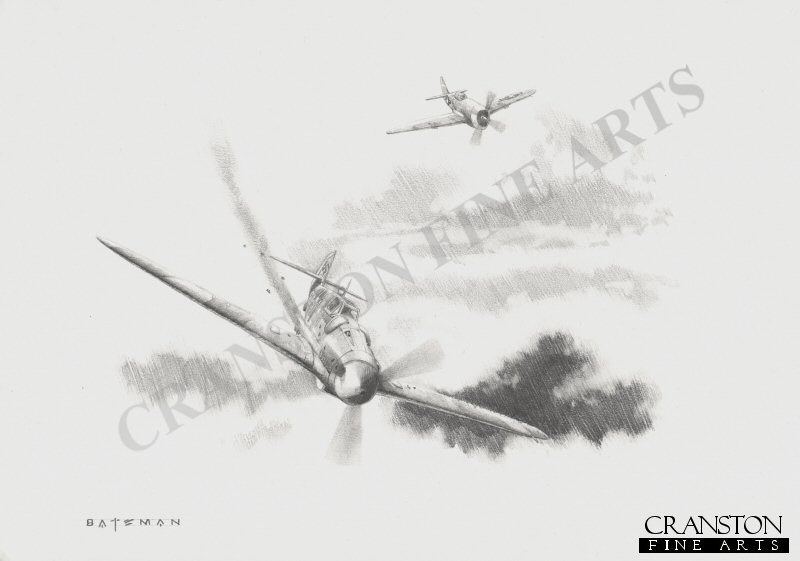
Victory for Red Section by Brian Bateman. Steve Pisanos, flying P-47 QP-D in Red Section, shoots down a German Me-109 near Sittard, Gemany. Here we see the 109 trailing smoke and banking down as Steve has hits near the engine and cockpit of the enemy combatant. Claim one Me-109. |
Eagles on the Rampage by Robert Taylor. Dominating the skies over Germany, P-51s of the 4th Fighter Group - The Eagles - sweep across the cloud tops, their pilots scanning the distant horizon for any signs of the Luftwaffe. They are ready for trouble should the enemy decide to chance their luck. The greatness of the Mustang is beyond doubt; it was the fighter pilot's ultimate machine. Tough, hard-hitting, it handled beautifully and - once the mighty Merlin engine had been included - possessed a performance unrivalled by any single piston-engined fighter of World War II. British inspired and American built, the P-51 was the aircraft the eager young pilots of the Eighth Air Force had been waiting for. Formed in September 1942 from the RAF Eagle Squadrons, the Fourth Fighter Group was the oldest fighter unit in the Eighth Air Force. Under the command of Don Blakeslee, described as probably the best fighter leader of the war, the combined air and ground victories notched up by 'The Eagles' during World War II surpassed any other fighter group. They were the first to penetrate German air space, and the first to engage the Luftwaffe over Berlin. Hermann Goering later remarked 'When I saw those Mustangs over Berlin, I knew that the war was lost'. Each print in this outstanding edition is signed by some of the most famous Mustang pilots that flew in the European Theatre during World War II. Every signatory in the edition has reached Ace status, creating a historic new collectors' edition which may never be surpassed. |
Air Combat Paintings Volume VI by Robert Taylor. Over seventy images of aviation art paintings by artist Robert Taylor. This 128 page book includes over 27,000 words of text and a foreword by lifelong aviation enthusiast Peter Jackson. |
Days of Thunder by Richard Taylor. Duxford became home to the 78th Fighter Group when they arrived in England with their P-47B Thunderbolts in 1943. The objective of the American fighter units was to gain air superiority over the Luftwaffe in support of their daylight bombing campaign. By 1944 they achieved their objective. Richard Taylor commemorates the valiant contribution of the 78th Fighter Group with a fine new rendition showing P-47D Thunderbolts departing Duxford en route for the north coast of France, and a low-level strafing mission. It is the spring of 1944, and with the Normandy invasion just days away, the Thunderbolts are already painted with invasion markings. |
Wounded Warrior by Richard Taylor. Like many other missions they had undertaken in the summer of 1944, this one had been particularly cold, tough and dangerous for pilot Harry Seip and the crew of B17G Silver Meteor. The First Lieutenant and his men had set out on that morning, 11th July 1944, from a peaceful Framlingham, on another arduous mission to Munich. With their bomb load dropped the crew headed for home, but the battle-scarred Fortress had been hit more than once, leaving the inner port engine shot out and Silver Meteor had steadily dropped behind the fast-disappearing bomber stream. Things were not looking good for Harry and his crew as the Luftwaffe fighters circled like sharks, closing in for an easy kill. Luckily the enemy pilots were not the only ones that had spotted the ailing Fortress. The P-51s of two of the best Aces in the Eighth Air Force - Bud Anderson and Kit Carson - had also seen the danger and came tearing out of the blue sky into the action. Within minutes the German pilots had fled and the crew of Silver Meteor could breathe a sigh of relief. With these two legendary Aces guiding them home, Harry and his men would survive to fight another day. Harry Seip is now the last surviving member of the crew of Silver Meteor. This remarkable event has lived vividly in his memory since the war and he has always been thankful to Bud Anderson for saving his life and those of his men. Unfortunately, these two outstanding heroes have never been able to meet, but thanks to this new edition both can finally come together to add authenticity to this remarkable story by personally signing this poignant edition. |
Devastating Thunder by Brian Bateman. (P) P-47D Thunderbolts, affectionately called 'Razorbacks' flown by Col Steve 'Spiro' Pisanos and his wingman of 334th Fighter Squadron, 4th Fighter Group, wreaking havoc on a German BR52 supply train over northern France in early 1944. Strafing targets of opportunity was, as Steve put it, exhilarating as hell but also extremely dangerous. Steve said that from his RAF training he learned never to pull up after the run, keeping low so as not to make yourself an easier target. |
|
Contact Details |
|
Sign Up To Our Newsletter!
This website is owned by Cranston Fine Arts. Torwood House, Torwoodhill Road, Rhu, Helensburgh, Scotland, G848LE Contact: Tel: (+44) (0) 1436 820269. Email: cranstonorders -at- outlook.com
|
|
|