|
|
|
|
|
 |
|
|
|
|
|
|
|
|
Franz Woidich
| Oberleutnant Franz Woidich (deceased) Franz Woidich was posted to North Africa to join II./JG27 in July 1941. In April 1942 he transferred to 3./JG52 in Russia. In August 1944 he was selected as one of a group of elite fighter pilots for training on the Me163 Komet, and joined Erganzunstaffel 400 at Gutenfeld, near Breslau. A month later he joined II./JG400 as Staffelkapitan. Franz Woidich served with JG400 until the end of the war. He was awarded the Knight's Cross in June 1944, flew over 1000 combat missions and achieved 110 victories.Franz Woidich passed away on 5th July 2004. |
|
|
|
|
|
| Text for the above items : |
Clipped Signature - Franz Woidich. Flew fighters from 1941 with JG27 and JG52 before being selected to fly the Me163 Komet rocket aircraft. Awarded the Knight's Cross, he scored 110 victories in more than 1000 missions during the war. He died in 2004. |
Kannonenboot by David Pentland. Adriatic coast, Greece, 20th Dece,ber 1943. 20mm cannon armed Messerschmitt 109G-6/R6 trop, flown by Oberleutnant Josef-Emil Clade, Staffelkapitan 7/JG27 White 9 and his wingman White 7. |
Caucasus Dawn by Graeme Lothian. Gunther Rall leading 111 JG52 squadron April 1943. |
Rocket Attack by Nicolas Trudgian. It required more than a little nerve to fly a fighter into the barrage of fire sprayed out by the gunners of a box of B17 bombers; it took even greater courage to do so in the rocket propelled Me163 Komet. With rocket science still in its infancy, these small aircraft were still in the experimental stage, and piloting what amounted to a flying bomb was in itself a perilous business, let alone flying them into combat. But these were desperate times. The day and night bombing assault on Germany was bringing the mighty war machine to its knees, and aything that might help stem the tide was thrown into battle. Powered by a mixture of two highly volatile chemicals, the slightest leak, or heavy landing could cause a huge explosion, and the mix was so corrosive that in the event of even a minor accident, the pilot could literally be dissolved. Sitting in a cramped cockpit, surrounded by dangerous chemicals and ammunition, the intrepid aviator would be launched into the sky on what was, at best, a four minute mission. After, hopefully, engaing the enemy, he would glide powerlessly back to the nearest airfield to be refuelled so as to attempt the hazardous operation all over again. Though limited to a handful of victories, the Komet did make the Allied crews wonder what else the Luftwaffe had hidden up its sleeve, and had the distinction of being the forerunner of aircraft technology that eventually took aircraft into space. Capable of nearly 600mph and climbing to 30,000ft in less than two minutes, this tiny rocket propelled Me163 Komet was typical of Germanys ingenuity in its desperate attempts to stem the havoc being wreaked by the USAAFs daylight bombers. |
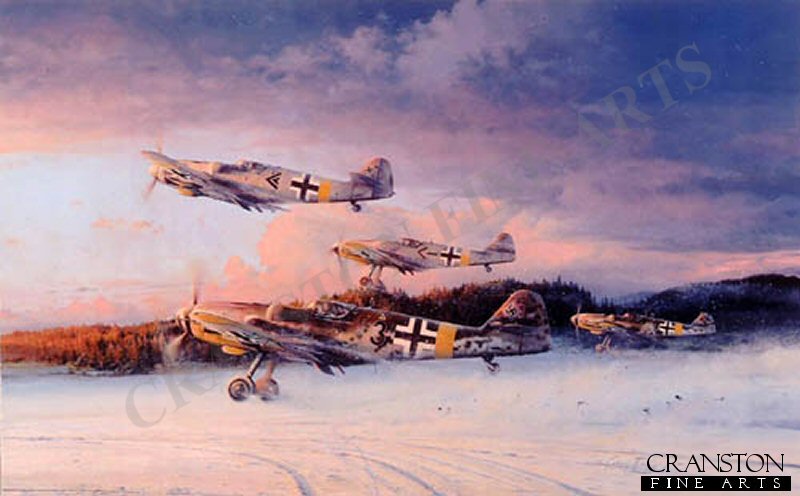
Eagles at Dawn by Robert Taylor. On Thursday, August 24, 1944 a 22-year old Oberleutnant Erich Hartmann powered his Mel09G fighter in a spectacular low pass over his squadrons airstrip in north-eastern Rumania, wagging his wings to the cheering Luftwaffe personnel on the ground below. The young flaxen-haired pilot had just become the first fighter Ace in history to bring down 300 enemy aircraft in combat. As World War II drew to its close, after three and a half years of continual aerial combat, this gifted young fighter pilot brought his final tally of aerial victories to 352, bringing down a Yak-7 during the last of his 1400 missions on May 8, 1945. He was the most successful fighter pilot of all time. In this dramatic rendition, we see captured a brilliantly colourful midwinter scene during the final phase of the war on the Eastern Front. Glinting in the sub-zero early morning sunlight as fresh snow begins to fall, and led by their Gruppenkommandeur Erich Hartmann, the Mel09G fighters of I./JG-53 scramble off the snow-covered airstrip at Veszprem in Hungary, February 1945. They will intercept waves of Russian fighters and bombers in the skies above Czechoslovakia in a last ditch attempt to repel the impending invasion of Germany. |
|
Contact Details |
|
Sign Up To Our Newsletter!
This website is owned by Cranston Fine Arts. Torwood House, Torwoodhill Road, Rhu, Helensburgh, Scotland, G848LE Contact: Tel: (+44) (0) 1436 820269. Email: cranstonorders -at- outlook.com
|
|
|