|
|
|
|
|
 |
|
|
|
|
|
|
|
|
Paul Egger
| Paul Egger (deceased) Knights Cross winning tank commander, SS Panzer Abteilung 502. Received Knights Cross 28th April 1945. 7th highest scoring Panzer Ace with a score of 113. Paul Egger was born in Mautern , Austria on the 23rd November 1916 and after finnishing high school in June 1935 he worked as a clerk until joining the Luftwaffe in late 1938. paul Egger was already a Glider Pilot and was trained as a bomber Pilot joining Kampfgeschader 51., Flying the Diver Bomber Junkers JU 87 Stuka. Paul Egger took part in the Invassion of Poland. he was then transferred tp Jagdeschwader 27 becoming a fighter Pilot flying the Messerschmitt BF 109 taking part in the Battle of france and the Battle of Britain, flying a total of 112 misions and was shot down three times. He had 2 kills. In his last mission he was shot down over the English Channel and had severe head wounds which stopped him flying and he was eventually transferred to staff duties. Paul Egger voluntered for the Waffen SS in May 1941 and was trained as aanti tank gunner. After traingin ghe moved to the Motorcycle Battalion of the Das reich division and transferred later to the 8th Compnay SS Panzer Regiment 2. As a tank commander he soon hsowed skill as a commander during the battle of Kieve he destroyed 28 tanks, 14 anti tank guns, 8 artillery batteries and 40 various Russian vehicles. In February 1943 durign the Thrid battle of Kharkov he recorded his 65th tank victory but his company was all but wiped out apart form his tank and one other. Paul Egger transferred to the 102 SS Heavy Panzer battalion commanding a Tiger tank in October 1943. After the D - Day landings. Paul Egger battalion was deployed to Normandy where he fought at point 122 destroying 14 allied tanks and 4 anti tank guns. His commander reccomended him for a knights cross for this action but received a German cross in Gold instead. Egger's battalion was almost completely destroyed during the fighting and in September 1944, and reformed in Sennelager Germany and renamed the 502 SS Heavy Panzer Battalion. In 1945 Egger was promoted to Untersturmfuhrer. 502 SS Heavy Panzer Battalion was sent to the Eatsern Front and fought around Stettin. paul Egger destroyed another 19 tanks during the fighting. In April 1945 Egger was promoted to Obersturmfuhrer took over command of the 1st Company. Egger recieved the Knight's Cross by Felix Steiner the commander of the XI SS Panzer Army Commander On the 3 May 1945, Paul Egger became the seventh top panzer ace recording his 113th tank destroyed. Paul Egger escaped from berlin and the Russian but surrendered to the American forces at the River Elbe after being shoot in the arm. he became a prisoner of war for 30 months and released in November 1947. Egger became a sports reporter. In civilian life he became a sports reporter. He died on 12 July 2007. |
|
|
|
|
|
|
|
|
|
|
|
|
|
|
|
| Text for the above items : |
Kerscher's Defence of Neuhauser Forest by David Pentland. Oberfeldwebel Albert Kerscher, commander of 2nd company 511 Heavy Tank Battalion aided by a Panzer IV, two Hetzers, a Kingtiger and a Pak gun, successfully defended against concerted Soviet air and armoured attacks, his action buying valuable time for the evacuation of German wounded from Pilau and scoring his 100th victory in the process. |
The Rearguard by David Pentland. Preussisch Stargard, East Prussia, February 1945. Following the departure of the platoon's two other vehicles, after expending all their ammunition, the single Jagdpanther of Oberfeldwebel Hermann Bix remained to cover the withdrawal of all supporting infantry in the area. Hidden behind a muck heap, with only twenty armour piercing and five high explosive shells remaining he made the attacking Soviet Shermans pay a heavy price, destroying sixteen of their number before he too fell back out of ammunition. |
The Long Road to Kharkov by David Pentland. Kharkov, Russia, February - March 1943. After abandoning Rostov and Kharkov in the face of the Soviet Winter Offensive, Field Marshal Erich von Manstein set about the recapture of both. Among those taking part in the ensuing counterattack was the newly promoted tank gunner Ernst Barkmann, of 2nd Company 2nd SS Panzer Grenadier Division, who had just been given command of his own Panzer III. |
The Tigers Roar, Malinava, Latvia, July 22nd 1944 by David Pentland. 1st Lieutenant Otto Carius commanding 2nd Company of the 502nd heavy tank Battalion, with eight Tigers, advanced towards the village of Malinava (a northern suburb of Dunaburg) , to halt the Russian advance. Following a reconnaissance Lieutenant Otto Carius explained his plan to take the village. He decided to attack using only two tanks because there was only one narrow road leading to the village. Six Tigers therefore remained in the reserve while Lt Carius and Lt. Albert Kerschers (one of the most decorated commanders of sPzAbt 502) tanks moved towards the village. Speed was the essence and afterwards, Otto Carius recalls that the entire battle did not last more than 20 minutes. in this short time, Carius and Kerscher knocked out 17 of the new JS-1 Stalin and 5 T-34 tanks. Following this he deployed 6 of his tanks in an ambush against the remainder of the Soviet tank battalion advancing toward him, unaware of their lead companies demise. Surprise was complete and a further 28 tanks were destroyed along with their supporting trucks and vehicles, the complete battalion had been wiped out for no loss. |
Panthers in the Fog by David Pentland. Mortain, France, 7th August 1944. Panther tanks of 1st SS Panzer Division 'Leibstandarde' attack units of US 30th Infantry Division in Mortain under cover of heavy fog. Following the successful American breakthrough at St. Lo, and the virtual collapse of the western half of the German line, Hitler ordered an immediate counterattack between Mortain and Avranches to halt the US forces. 'Operation Luttich' was the code name given to this last major German counterattack in Normandy. Initially successful the operation was doomed to failure once the weather cleared and the US air support was brought to bear. |
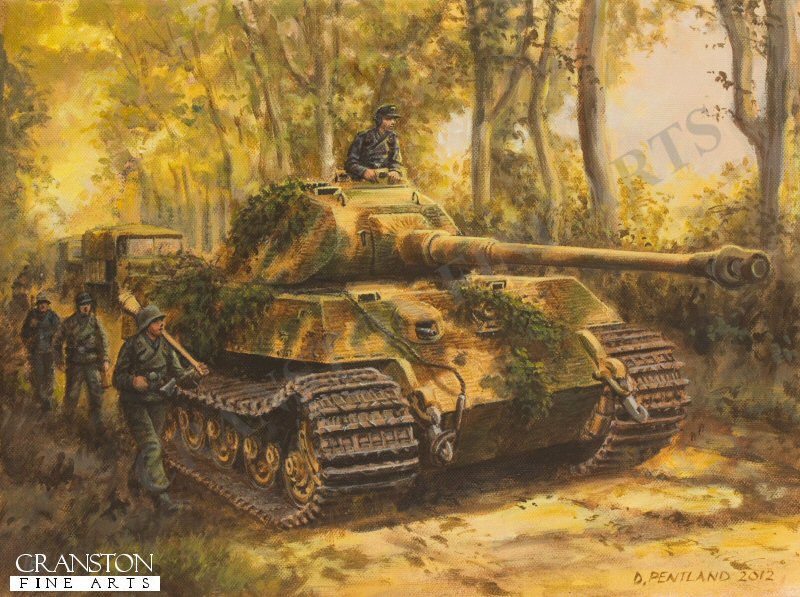
Tigers in the Mist by David Pentland. King Tigers of Kampfgruppe von Rosen, 3rd Company Heavy Tank Battalion 503, preparing to move out from the Tisza bridgehead to counter Soviet pressure on German forces attacking to the northwest at Debrecen during the first battles to defend the Hungarian capital of Budapest. |
Finale at Arnhem, Holland, 24th September 1944 by David Pentland. In the predawn light the last Pz.Kpfw. VI Tiger II (Kingtigers) of 2nd Company 506th Heavy Tank Battalion, drive south across the Arnhem bridge to prepare for the upcoming counter-attack to retake Elst and the Nymegen road bridge. |
The Shepherd by David Pentland. Orville, Normandy, 20th August 1944. Within days of the death of his friend and commander Obfw. Fendesack, Feldwebel Kurt Knipsel climbed into the last remaining Tiger II of 1st Company 503rd Heavy Tank Battalion as a tank commander. While leading the unit's retreat to the Seine he more than once saved it by knocking out allied tanks at extreme visual range. On the 28th the column reached Pontiose, and safety. |
Prepare to Ram, Operation Goodwood, normandy, 18th July 1944 by David Pentland. While probing forward near Cagny on the initial day of the Goodwood offensive, Lt John Gorman, a troop commander of 2nd Armoured Battalion, Irish Guards, suddenly found himself confronted by a Tiger II and three Tiger Is of the elite 503rd Heavy Tank Battalion. Supported by only one other Sherman, and aware that their 75mm guns would be ineffective against such monsters, he gave the order to his driver to ram the King Tiger. Gorman's tank Ballyragget succeeded in colliding with its target before the Tiger's 88mm gun could be brought to bear on his Sherman, and with both tanks immobilised the crews quickly abandoned their tanks. Lt. Gorman, however, was not finished and making his way off the field, he returned shortly afterwards with a Sherman Firefly, to finish off the stricken Tiger II and one of the Tiger Is. For this action he was awarded the Military Cross, and his driver L/Cpl Baron the Military Medal. |
Clipped Signature - Paul Egger. Knights Cross winning tank commander, SS Panzer Abteilung 502. Received Knights Cross 28th April 1945. 7th highest scoring Panzer Ace with a score of 113. Paul Egger was born in Mautern , Austria on the 23rd November 1916 and after finnishing high school in June 1935 he worked as a clerk until joining the Luftwaffe in late 1938. paul Egger was already a Glider Pilot and was trained as a bomber Pilot joining Kampfgeschader 51., Flying the Diver Bomber Junkers JU 87 Stuka. Paul Egger took part in the Invassion of Poland. he was then transferred tp Jagdeschwader 27 becoming a fighter Pilot flying the Messerschmitt BF 109 taking part in the Battle of france and the Battle of Britain, flying a total of 112 misions and was shot down three times. He had 2 kills. In his last mission he was shot down over the English Channel and had severe head wounds which stopped him flying and he was eventually transferred to staff duties. Paul Egger voluntered for the Waffen SS in May 1941 and was trained as aanti tank gunner. After traingin ghe moved to the Motorcycle Battalion of the Das reich division and transferred later to the 8th Compnay SS Panzer Regiment 2. As a tank commander he soon hsowed skill as a commander during the battle of Kieve he destroyed 28 tanks, 14 anti tank guns, 8 artillery batteries and 40 various Russian vehicles. In February 1943 durign the Thrid battle of Kharkov he recorded his 65th tank victory but his company was all but wiped out apart form his tank and one other. Paul Egger transferred to the 102 SS Heavy Panzer battalion commanding a Tiger tank in October 1943. After the D - Day landings. Paul Egger battalion was deployed to Normandy where he fought at point 122 destroying 14 allied tanks and 4 anti tank guns. His commander reccomended him for a knights cross for this action but received a German cross in Gold instead. Egger's battalion was almost completely destroyed during the fighting and in September 1944, and reformed in Sennelager Germany and renamed the 502 SS Heavy Panzer Battalion. In 1945 Egger was promoted to Untersturmfuhrer. 502 SS Heavy Panzer Battalion was sent to the Eatsern Front and fought around Stettin. paul Egger destroyed another 19 tanks during the fighting. In April 1945 Egger was promoted to Obersturmfuhrer took over command of the 1st Company. Egger recieved the Knight's Cross by Felix Steiner the commander of the XI SS Panzer Army Commander On the 3 May 1945, Paul Egger became the seventh top panzer ace recording his 113th tank destroyed. Paul Egger escaped from berlin and the Russian but surrendered to the American forces at the River Elbe after being shoot in the arm. he became a prisoner of war for 30 months and released in November 1947. Egger became a sports reporter. In civilian life he became a sports reporter. He died on 12 July 2007. |
Typhoon's End by David Pentland. Volokolamsk, Moscow, December 1941. Panzer III's and Panzergrenadiers of the 11th Panzer Division press on towards Moscow in the final stages of Operation Typhoon. Ultimately doomed to failure by the freezing weather and tenacious Soviet defence, this proved to be the high water mark of the Axis advance on the Soviet capital. |
Counter Attack at Villers Bocage by David Pentland. A handful of Tigers from 2nd Kompanie SS Schwere Panzer Abteilung 101 halted the advance of the British 7th Armoured Division, The Desert Rats, outside the little Norman village of Villers Bocage. Prowling through the streets of the village, the solitary tank of Hauptsturmfuhrer Michael Wittmann knocked out most of the 4th County of London Yeomanry's regimental HQ Stuart and Cromwell tanks, before falling victim to a 6pdr anti-tank gun. Wittmann survived the battle but was killed a month later on August 8th 1944. |
The Last Bridge by David Pentland. Floridsdorf, Vienna, 3th April 1945. By mid April the Soviet assault had almost cleared German resistance from the south bank of the Danube. Only one small bridgehead remained open to allow troops a chance to escape, and this exit was defended by only 2 tanks and a few anti-tank guns. Defending the eastern approaches to the bridge was the Panther tank of SS Obersturmfuhrer Arnold Friesen, 2nd SS Panzer Division. Despite being only 19 he was a veteran of Kursk, Normandy, the Ardennes and Hungary with a tally of 97 tank kills to his credit. By the end of the day Friesen and his crew accounted for a further 14, (the last two with panzerfausts), before covering the final withdrawal of the last German units across the bridge under cover of darkness. |
Kampfgruppe Carius by David Pentland. Near Lake Ricu, 12th - 16th July 1944. |
Retaking Tirtsu by David Pentland. Albert Kerscher and Otto Carius. Narva Bridgehead, 18th March 1944 - 2nd Company, 502 Heavy Tank Battalion and Nordland Infantry. |
|
Contact Details |
|
Sign Up To Our Newsletter!
This website is owned by Cranston Fine Arts. Torwood House, Torwoodhill Road, Rhu, Helensburgh, Scotland, G848LE Contact: Tel: (+44) (0) 1436 820269. Email: cranstonorders -at- outlook.com
|
|
|