|
|
|
|
|
 |
|
|
|
|
|
|
|
|
Roland Bee Beamont
| Wing Commander Roland Bee Beamont CBE DSO DFC DL (deceased) One of World War IIs great characters, Bee flew Hurricanes with 87 Squadron, later leading a Tempest Wing. He had 8 victories plus a further 32 VIs destroyed. After the war he became a highly respected Chief Test Pilot.Wing Commander Roland Beamont, one of the RAFs top buzz bomb interceptors, was born in Enfield England on August 10, 1920. Educated at Eastborne College, Beamont accepted a short service commission with the Royal Air Force in 1938. He commenced flying in 1939 at the the No. 13 Reserve Flying School at White Waltham. His initial duty was with the Group Fighter Pool at St. Athan where he learned to fly the Hurricane. Beamont was soon posted with the No. 87 Squadron which was part of the Advanced Air Striking Force in France. Seeing action in both France and Belgium prior to the Allied withdrawl, Beamont rejoined 87 Squadron in England during the Battle of Britain. In the spring of 1941 Beamont was awarded the Distinguished Flying Cross after destroying five enemy aircraft. As Commanding Officer of 609 Squadron, Beamont pioneered both day and night ground attack missions utilizing the Typhoon. Beamont was credited with destroying 25 trains in a three month period. He was then made responsible for organizing and commanding the first Tempest Wing at Newchurch. Three days after D-Day Bearnont shot down an Me-109, marking the first aerial combat victory for the Hawker Tempest. In the summer of 1944 Beamont destroyed 32 buzz bombs prior to leading his wing to a Dutch Airfield at Volkel on the Continent. In October of 1944 Beamont was shot down during a ground attack mission over Germany, and he remained a prisoner of war until wars end. Following repatriation Beamont became an experimental test pilot with the Gloster Aircraft Company, which had developed the RAFs first jet aircraft. Turning down a permanent commission with the RAF, Beamont then joined English Electric Company in Wharton as the Chief Test Pilot for the B3/45 (Canberra) jet bomber program. He managed all prototype testing on the Canberra, and in the process set two Atlantic speed records. Later Beamont was involved with the supersonic P1/Lightning program, and became the first British pilot to fly at twice the speed of sound. From 1965 until 1970 he was a founding member of Britains highly succesful Saudi Arabian export program. For several years prior to his retirement in 1979, Beamont was Director of Operations for British Aerospace and Panavia where he was in charge of flight testing for the Tornado. Since his retirement Beamont has authored nine books, and published numerous magazine articles. He is a Fellow of the Royal Aeronautical Scociety and an Honorary Fellow of the Society of Experimental Test Pilots in America. He died 19th November 2001. |
| Navigation | |
| Page 1 of 2 | Page 1 .. Next |
|
|
|
|
|
|
|
|
|
|
|
|
|
|
|
|
|
|
|
|
|
| Navigation | |
| Page 1 of 2 | Page 1 .. Next |
| Text for the above items : |
Overturning the Odds by Keith Woodcock With all his ammunition spent on other interceptions, Wing Commander Beamont in his Hawker Tempest MKV tips a German flying VI bomb to its destruction with his wingtip during the summer of 1944. |
501 Squadron Hurricanes by Ivan Berryman. Group Captain Byron Duckenfield on patrol in Hurricane P3059 of No.501 Squadron during the Battle of Britain. |
Hurricane Heroes by Nicolas Trudgian. Hurricanes of 87 Squadron return to their West Country base after repelling attacks by Luftwaffe bombers on nearby aircraft factories, August 1940. Flight Lieutenant Ian Gleeds Hurricane, in which he scored 20 victories, leads the Squadron pilots back to base to refuel, re-arm, and get airborne without delay. Published 2000. Signed by three famous Hurricane pilots who fought in the Battle of Britain. These are three fantastic rare signatures to have on one art print and sadly all three have since passed away. |
Wing Commander J R Baldwin - The Spoils of War by Ivan Berryman. Britain's highest scoring Typhoon ace, Wing Commander J R Baldwin climbs from the cockpit of his personalised Typhoon at a makeshift airfield in northern France after a sortie in support of the Allied forces' drive into mainland Europe following D-Day in June 1944. Baldwin was instrumental in the capture of a German General's Mercedes, a prize which he employed as his personal transport for the duration of his time in France. |
Striking Back by Gerald Coulson. Conceived initially by Hawkers (of Hurricane fame) as a fast powerful fighter, the Typhoons performance in this role proved to be disappointing in the respect of rate of climb, and at height. They did however eventually come into their own as a superlative very fast ground attack aircraft, and combined with the skill of their pilots became one of the most potent weapons of World War Two. This painting conveys something of the drama of a pair of typhoons at take-off, each loaded with two 1000lb bombs. Normandy dust contributes to the backdrop. |
Hard Hitter by Ivan Berryman. Whilst in command of 609 Sqn in January 1944, F/Lt (later Wing Commander) J R Baldwin, leading a small formation of Hawker Typhoon 1Bs, encountered thirty Focke-Wulf Fw190s and engaged them in a furious battle. Nine enemy aircraft were shot down in the action, Baldwin accounting for two of them himself. He went on to finish the war as the highest-scoring Typhoon pilot of all with 15 confirmed victories, one shared, one probable and four damaged. He is depicted here, flying DN360 with the codes PR-A. |
Tribute to Flt Lt Ian R Gleed by Ivan Berryman. Flight Lieutenant Ian Widge Gleed is depicted in his personal Hurricane 1 P2798 (LK-A) of 87 Sqn shooting down a Messerschmitt Bf.110 on 15th August 1940. Just visible beneath the cockpit of the Hurricane is his mascot, Figaro, shown kicking a swastika. His aircraft was also easily identifiable by the red flash on its nose, a feature that was retained even when P2798 was painted all black for its night fighter role. Gleed scored many victories before being shot down and killed whilst flying a Spitfire Vc in the Western Desert in April 1943. |
Front Line Hurricanes by Robert Taylor. Based at a temporary formed airfield at Lille Marc, Hurricanes of No. 87 Squadron - showing the strains of battle - taxi in from a skirmish during heavy fighting in the Battle of France, May 1940. |
A Busy Day at the Office by Ivan Berryman. The leadership qualities and grim determination of Squadron Leader J R Baldwin was seldom better demonstrated that when he led a small flight of Hawker Typhoons against a force of some thirty Focke-Wulf Fw.190s in January 1944. Nine of the German aircraft were shot down that day, Baldwin himself being responsible for two of them. He is shown here in Typhoon PR-A of No.609 Squadron. |
Lull Before the Storm by Keith Aspinall. The Tempest of Wing Commander Roland Beamont DSO and Bar DFC and Bar, June 1944. |
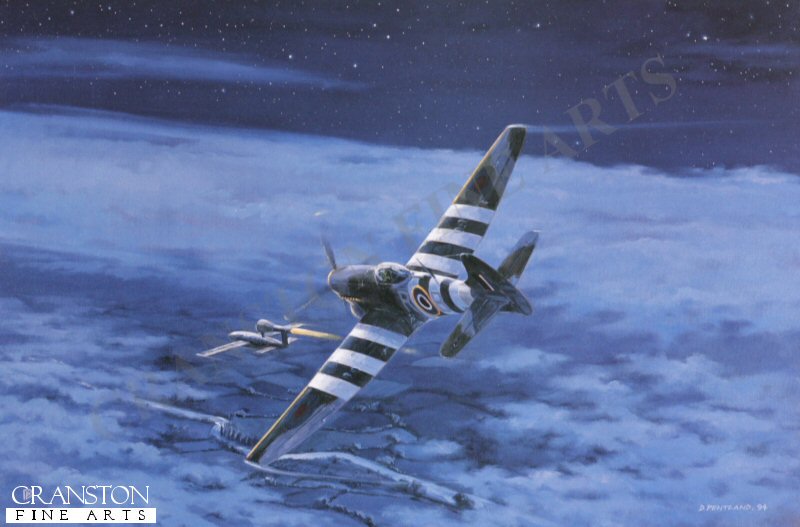
A Buzz for Beamont by David Pentland. Wing Commander Roland Beamont in his personal Tempest V, intercepted and downed his first V1 Buzzbomb on the night of June 22nd, 1944, over south east England. As Commander of 150 wing and others he went on to shoot down a total of 30 V1 flying bombs, 8 enemy aircraft and 35 locomotives destroyed plus one minesweeper sunk. |
Tribute to Squadron Leader Derek Ward by Ivan Berryman. The early months of 1942 saw Sqn Ldr Derek Ward flying several sorties a day, many of them at night with 73 Sqn in the skies above Egypt. He claimed a Heinkel 111 destroyed on 9th February and a Bf.109 just a few days later. Then, on the night of 1st May, Ward spotted a Focke-Wulf Fw.200 Condor heading out to sea. Alone, he pursued the German four-engined bomber in his Hurricane and shot it down, flames streaming from its wing. For this action, Sqn Ldr Ward was awarded the DFC. |
Clipped Signature - Roland Beamont. An Ace pilot who flew Hurricanes during the Battle of Britain and later the Tempest, noted for destroying V-1 flying bombs. He died in 2001. |
The Exterminator by Stan Stokes. By mid-1941 it was clear that Hitlers plans to invade Britain were in disarray. The RAF had fought the Luftwaffe to a standoff, and many of Germanys top pilots had been killed or captured. Not willing to admit defeat in his campaign against Britain, Hitler approved the development of a pilotless terror weapon, the VF-1 Vergeltungswaffe (retaliation weapon). Designed by the Feiseler Company, the small pilotless Fi-103 was at times referred to in Britain as the doodlebug, buzz bomb, or farting fury. These flying bombs were inexpensive to build and were capable of carrying an 1870-pound warhead. The Fi-103 was powered by a ram-jet engine, and utilized three air driven gyroscopes to orient the aircraft. A rudimentary pre-set propeller device was utilized to determine when the VF-1 would land. Lacking the accuracy necessary to make it an effective weapon against military targets these doodlebugs were primarily targeted at large population centers. Therefore, they were primarily used as civilian terror weapons, and the RAF was given the assignment of providing the defense against these terror weapons. Early testing revealed many problems with the VF-1, and it was not until March 1944 that most of these problems had been worked out. The final VF-1 production models were capable of speeds in excess of 400 MPH . The high speed of the VF-1, coupled with its small size and large warhead, made it difficult for the RAF to shoot down these doodlebugs. The doodlebug had strong sheet steel skin which deflected machine gunfire, making it necessary to utilize cannon fire. Cannons had more than twice the range of machine guns, but the attacking fighters had to get in close to hit these small, fast targets. If the pilot got in too close the explosion of the VF-1s heavy warhead often disabled the attacking fighter. An alternative was to deflect the doodlebug by maneuvering alongside it, and then by executing a gentle banking maneuver, flip the VF-1, and disrupt its gyros. Generally, this caused the doodlebug to crash in an unpopulated area with little damage. Less than 10% of the buzz bombs were destroyed in this manner, and this technique was only utilized when the pilot had depleted his ammunition. One of the top buzz-bomb exterminators was Wing Commander Roland Beamont who destroyed 32 doodlebugs during his tour of duty. He flew the Tempest V with 150 Wing, which he commanded. The three squadrons of 150 Wing were credited with destroying 630 buzz bombs between June and August of 1944. The Hawker Tempest was the fastest interceptor available, and provided its pilots a highly stable platform for its four 20mm cannon. The Meteor, the RAFs first jet, was utilized briefly as a buzz bomb interceptor, but with only nine kills, it was withdrawn as being unsuitable for this purpose. As depicted in Stan Stokes painting appropriately entitled The Exterminator, Wing Commander Beamont is depicted flying his Tempest V through the debris created by a successful hit on a buzz bomb in July, 1944. The action takes place southeast of London over the tranquil English countryside. |
An Early Bath by Ivan Berryman. In the early evening of the 18th of July 1941, following coastguard reports of an enemy aircraft in their vicinity, two Hurricanes of 87 Sqn on detachment at the Airfield at St Mary's, Scilly Isles were scrambled to an area some 30 miles south west of the Scilly Isles where they intercepted a lone Heinkel He111. Alex Thom was the first to attack, his windscreen being sprayed with oil as his rounds tore into the Heinkel's starboard engine. Breaking away, his wingman F/O Roscoe now took over the chase, but the German bomber was already mortally wounded and was observed to alight onto the sea where upon the crew immediately took to their life raft as the Heinkel began to sink beneath the waves just minutes later, Thom circled overhead until he saw the motor launch arrive to pick up the German aircrew before returning back to St Mary's. |
Hurricane Mk.IIC by Ivan Berryman. Hurricane Mk.IIC Z3971 of 253 Sqn, closing on a Heinkel 111. |
Hawker Typhoon Squadron by Frank Wootton. No text for this item |
Doe's Griffin by David Pentland. Portland, England, 30th September 1940. Already an accomplished Spitfire ace with at least 10 confirmed kills, Bob Doe had just transferred from 234 squadron to 238 Hurricane squadron when he intercepted and brought down a Heinkel He111P-2 from I/KG55 Griffin Geschwader. |
Tangmere Hurricanes by Nicolas Trudgian. MK1 Hurricanes of No. 601 Squadron refueled and rearmed, climb to rejoin the battle during the summer of 1940. As the great air battle rages high above, life goes in the countryside as a Southern Railway train pulls out of a local village station, capturing the resilient mood of the people. |
Typhoon! by Ivan Berryman. So often overshadowed by its own achievements as a ground attack aircraft, Hawkers mighty Typhoon also proved itself a formidable adversary in air to air combat as demonstrated by the successes of F/Lt (later Wing Commander) J R Baldwin who claimed no fewer than three Bf.109G4s in the skies above Kent on 20th January 1943 in a single sortie. Baldwin finished the war as the highest-scoring Typhoon pilot of all with 15 confirmed victories, one shared, one probable and four damaged. He was tragically lost over Korea in 1952 whilst on an exchange posting with the USAF, but is depicted here at the peak of his powers, flying Typhoon 1B DN360 (PR-A) of 609 Sqn. |
Legend - TSR.2 by Ivan Berryman. Viewed by many as the most advanced and forward-thinking design for an attack and reconnaissance aircraft in its day, the BAC TSR.2 was to fall victim to inter government wrangling and the absurd belief by those in power in the mid 1960's that the days of the manned fighter aircraft were over and that all future conflicts would be fought with missiles. Eventually exploring tried and tested American aircraft to re-equip the RAF, the extraordinary TSR.2 project was abandoned, leaving the British military aviation industry bruised, angry and in tatters. No all-British military aircraft has been conceived or constructed since and it is almost certain that this remarkable aircraft would have continued in front line service for at least two decades had it been allowed beyond its difficult gestation. |
| Navigation | |
| Page 1 of 2 | Page 1 .. Next |
|
Contact Details |
|
Sign Up To Our Newsletter!
This website is owned by Cranston Fine Arts. Torwood House, Torwoodhill Road, Rhu, Helensburgh, Scotland, G848LE Contact: Tel: (+44) (0) 1436 820269. Email: cranstonorders -at- outlook.com
|
|
|