|
|
|
|
|
 |
|
|
|
|
|
|
|
|
Post-WW2 Era Military Art Print List
Cranston Military Prints  By Subject Military Art Modern Wars By Subject Military Art Modern Wars  Modern Military Art Print List Modern Military Art Print List |
[UP] - Korean War - Vietnam War - Northern Ireland - Falklands Conflict - Gulf War - The Balkans - Afghanistan - Iraq - Modern Military Art Print List |
| Complete list of military art prints and paintings depicting post-war military scenes. This gallery includes conflicts and wars like Vietnam, Kosovo and Iraq, as well as depicting modern day troops and artillery in peacetime. |
| Navigation | |
| Page 1 of 13 | Page 1 .. Next |
|
|
|
|
|
|
|
|
|
|
|
|
|
|
|
|
|
|
|
|
|
| Navigation | |
| Page 1 of 13 | Page 1 .. Next |
| Text for the above items : |
The Ceremony of the Keys, HM Tower of London by David Rowlands. Depicting the 1st Battalion The Royal Regiment of Wales at the ceremony of the keys. |
Quo Fata Vocant by David Rowlands. First Fusiliers Battlegroup leading 7th Armoured Brigade into Iraq. 21st march 2003 Operation Telic. |
100 at 30 by Scott Kirkwood. Commissioned by 100 (Yeomanry) Regiment, Royal Artillery in 1997 to commemorate Regimental 30th birthday. Last deployment of FH70 155mm howitzer on Salisbury Plain prior to decommissioning. |
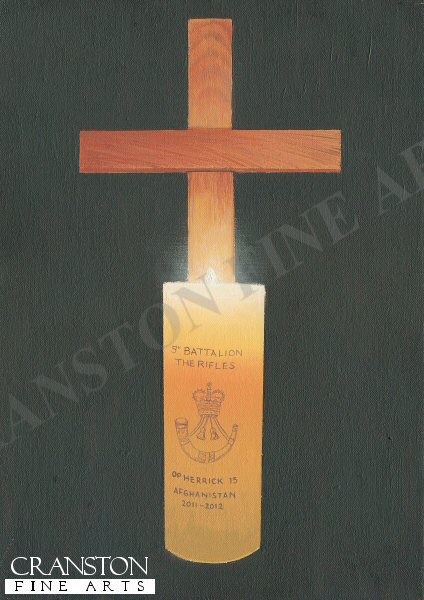
Candle and Cross by Graeme Lothian. Christmas Eve at PB2 (Patrol Base 2) in Nahr E Saraj. |
S.A.S. Urban Counter-Terrorism by Chris Collingwood. No text for this item |
SAS - Defending the Mortar Pit at Mirbat by Jason Askew. (P) 19th July 1972, Mirbat, Oman. Men of the Special Air Service defend the mortar pit in one of the most famous engagements in the regiment's history. The painting depicts the action looking towards the coast. Captain Mike Kealy is the central figure kneeling and firing, whilst Thomas Tobin is on the left, and Sekonaia Takavesi is firing over the sandbags in the middle distance. At this stage of the action, Talaiasi Labalala had already been fatally injured while single-handedly firing the artillery piece - usually a job for a team of six men. |
Eagle Patrol by John Wynne Hopkins. Lynx Mk7 deplanes chalk, South Armagh. |
The Kacanick Defile by David Rowlands. Operation AGRICOLA. On 12th June 1999, 5 Airborne Brigade spearheaded the KFOR advance into Kosovo by securing the Kacanik Defile ahead of the ground forces. The Brigade's joint airmobile operation with the UK support helicopter force followed a rapid strategic insertion to theatre. |
Headquarters Squadron, 1st The Queens Dragoon Guards, Umm Qasr, Iraq, 2003 by David Rowlands. No text for this item |
Insertion by David Pentland. Helmand Province, Afghanistan, July 2009. Troops from the Black Watch, 3 Battalion, Royal Regiment of Scotland (3 SCOTS) and Royal Engineers are deployed by RAF Chinook helicopters as part of Operation Panther's Claw. |
24 Air Mobile by John Wynne Hopkins. British infantry are airlifted during major patrols in Northern Ireland during the troubles. The troops are transported by Army Air Corps Lynx helicopters, with a Chinook dropping equipment in the distance. |
Shura by Graeme Lothian. Shura is an Arabic word meaning 'consultation'. It is mentioned three times in the Quran as a praiseworthy activity. ISAF forces sit down to discuss local events and to exchange views over a pot of sweet tea. Sitting cross-legged, the ISAF are allowed to wear their boots and the locals fully understand that Europeans cannot sit cross-legged for even a short time. |
Strike on Karbala by James Dietz. After completing a Relief-In-Place (RIP) with the 1st Brigade Combat Team (BCT) in An Najef, Iraq at 040700L April 2003, the 2nd BCT 101st Airborne Division (Air Assault) (The STRIKE Brigade) went into an abbreviated planning process for an attack on Karbala to destroy remnant Saddam Fedayeen and paramilitary forces. Following the RIP, select members of the Brigade staff and the Assistant Division Commander for Operations flew to and conducted a battle handover briefing for the mission to Karbala with the 3rd Brigade, 3rd Infantry Division. Upon return, 2nd BCT executed a hasty mission planning sequence as the 101st Division Main Effort and issued a Fragmentary Order (FRAGO) at 041800L April 2003. That evening at 2100L, the Brigade TAC departed the Al Kifl base of operations and linked-up in a Position Area for Artillery (PAA) with 1-320 FA TOP GUNS in preparation for the next mornings attack. In addition to its organic elements, the Brigade was augmented with 2-70 AR, 1st Armored Division; C/1-41 IN (M) 3-101 Attack Aviation; and 2-17 CAV. Artillery support included 1-320 FA, 3-320 FA and C/1-377 FA, including a battery of MLRS from C/2-37 FA. Total artillery assets consisted of 36 guns, 2 launchers, and 3 radars. In total 2nd BCT consisted of 10 battalions. The plan required a Ground Assault Convoy (GAC) move up Highway 9 with a simultaneous air assault from a series of PZs around Al Kifl into three LZs around the city. For the operation Karbala was divided into 4 zones and then sub-divided into 30 separate sectors sequentially lettered from A through DD. The Brigade Main Effort, 3-502 Infantry, departed from PZ BIRCH and landed to the northwest of Karbala on LZ SPARROW and was tasked to destroy a company plus of Fedayeen fighters. Supporting the brigade main effort was 1-502 Infantry, which departed from PZ PINE and landed to the southeast on LZ FINCH. Also in support was 2-502 Infantry, which departed from PZ MAPLE and landed to the southwest on LZ ROBIN. The plan called for the infantry to clear its assigned sectors with 2-70 AR, positioned to the east of the city, responsible for tightening the noose along the key re-supply routes to Baghdad; aviation and artillery units were in support. H-hour was set for 051100L April 2003 and began with a half-dozen airstrikes using satellite-guided Joint Direct Attack Munition (JDAM) bombs against paramilitary arsenals. 23 UH-60 Black Hawk helicopters and 5 twin-rotor CH-47 Chinooks shuttled three 502nd Infantry battalions (a total of 731 soldiers) into their respective landing zones around the city. Then, in swirling dust and over 102 degree heat, 28 M1 Abrams tanks and 16 M2 Bradley Fighting Vehicles roared in from the east and northeast along Route Venezuela -- a hammer against the infantry anvil. Resistance was heavy. The infantry battalions soon found themselves immersed in street clearance against a determined, but unstructured enemy, armed with an array of militia weapons. 3-502 IN (ME) bore the brunt of it. Its companies had entered the city after an unexpectedly long approach march from LZ Sparrow and, once inside, became embroiled in a series of skirmishes that demanded junior leadership of the highest standards. Further south, 2-502 IN moved in similarly methodical fashion, street-by-street, building-by-building. Stockpiles of arms were found in schools and homes. 1-502 IN, pressing in from the southeast of the city, denied the enemy access to multiple caches. 2-17 CAV provided brave and unquestioning support in destroying targets hindering the infantrys advance by either independent action or by marking targets for artillery and Close Air Support (CAS) to engage. By nightfall, 2nd BCT had cleared and secured 13 of their 30 sectors. It had secured a frightening amount of weaponry, including 2 ZPUs, 5 S60s, 14 mortar systems and 36 RPG launchers. It found a possible terrorist training camp, replete with bunkers, obstacle courses and planning tables. Artillery batteries fired more than 100 smoke canisters to screen infantrymen moving onto the streets. Through the next day 2nd BCT infantry units cleared the remainder of their sectors, at times still encountering resistance. Each and every school system was found to contain some sort of weapons cache, Saddam Hussein propaganda, and evidence of foreign insurgent assistance. Baath Party Headquarters were stocked with Oil for Food, rice and flour bags, as well as audio/video and Pro-Hussein political paraphernalia. Karbala was considered cleared of any subversive elements and deemed secure by 061700L April 2003. At aproximately 061730 April 2003, the 20 foot steel molded statue of Saddam Hussein was symbollically torn from its pedestal by elements of the 2-70 Armor battalion and the Iraqi people. Though the Brigade departed Karbala on 071600 APR, 1-502 IN battalion remained in the city until 10 April to conduct a RIP with the 2nd Brigade from the 82nd Airborne Division. The STRIKE Brigade suffered multiple casualties including the death of SPC Larry Brown of C/1-41 IN (M), who died when an RPG hit his Bradley. Hundreds of enemy, mostly Syrians and militia fighters, had been killed. Scores of caches had been discovered and consolidated at the Brigade Supply Area (BSA) resulting in a large international media presence in the city on 7 April. The Battle for Karbala was a successful execution of joint warfare using a combined-arms capability in an urban environment. It was the premier battle of the war for the 2nd BCT. The actions of the 2nd BCT eliminated Iraqi attacks on V Corps Lines of Communication (LOC) and allowed the attack toward Baghdad to continue unhindered. |
Cobra Attack by David Rowlands. AH-1 Whiskey Cobras of the US marine Corps in Action, Kuwait, February 1991. |
Wildman Rescue by John Wynne Hopkins. No text for this item |
Howay the Lads by David Rowlands. Y Company of 1st Battalion The Royal Regiment of Fusiliers assault Bridge 2 over the Shatt al Basrah waterway under heavy fire on the morning of 23rd March 2003. |
Royal Artillery by Graeme Lothian. A Royal Artillery team sight and prepare to fire a 105mm light gun, Patrol Base Attal. |
Close Support by David Rowlands. 35 Engineer Regiment 2000. |
Surgeons of Camp Bastion by Graeme Lothian. No text for this item |
The Road to Basra, Southern Iraq, 7th April 2003 by David Pentland. Challenger II tanks of the Royal Scots Dragoon Guards, and Warrior APCs of the Irish Guards, 7th Armoured Brigade, the Desert Rats supported overhead by US Marine Corps Cobras during their epic dawn attack to finally take and secure Basra. |
A Hot Night in Basra by David Pentland. 2 R Welsh Battle Group strike into Basra City, summer 2007. The original painting was commissioned by the regiment. |
| Navigation | |
| Page 1 of 13 | Page 1 .. Next |
|
Contact Details |
|
Sign Up To Our Newsletter!
This website is owned by Cranston Fine Arts. Torwood House, Torwoodhill Road, Rhu, Helensburgh, Scotland, G848LE Contact: Tel: (+44) (0) 1436 820269. Email: cranstonorders -at- outlook.com
|
|
|