|
|
|
|
|
 |
|
|
|
|
|
|
|
|
Battle of Trafalgar
Cranston Military Prints  By Subject Naval Art Age of Sail  Trafalgar |
[UP] - Algiers - St Jean D'Acre - Cape St Vincent - Copeland Islands - Copenhagen - Finnisterre - Glorious 1st of June - Helgoland - Malaga - The Nile - San Domingo - Texel - Trafalgar - Spanish Armada - Ships - Age of Sail Print List |
| Battle of Trafalgar. Age of Sail naval art prints of the Battle of Trafalgar. |
| Navigation | |
| Page 3 of 4 | Previous .. Page 3 .. Next |
|
|
|
|
|
|
|
|
|
|
|
|
|
|
|
|
|
|
|
|
| Navigation | |
| Page 3 of 4 | Previous .. Page 3 .. Next |
| Text for the above items : |
The Victory towed into Gibraltar after Trafalgar by William Clarkson Stanfield. No text for this item |
The Battle of Trafalgar by William Stuart. No text for this item |
HMS Victory About to Break the Line by Bill Bishop. HMS Victory leading her division is just altering course to starboard in order to pass under the stern of Bucentaure flagship of Admiral Villeneuve, to rake her and break the line during the battle of Trafalgar. |
The Battle of Trafalgar by William Stuart. No text for this item |
HMS Victory at the Battle of Trafalgar by Graeme Lothian. The time is 1.35pm. (ten minutes after Admiral nelson had been fatally shot) HMS Temeraire and HMS Victory, are seen broadside to the redoubtable, which by 2pm had lost most of her crew, (out of a crew of 643 - 487 were dead, 81 died soon after, and only 25 were fit to crew) |
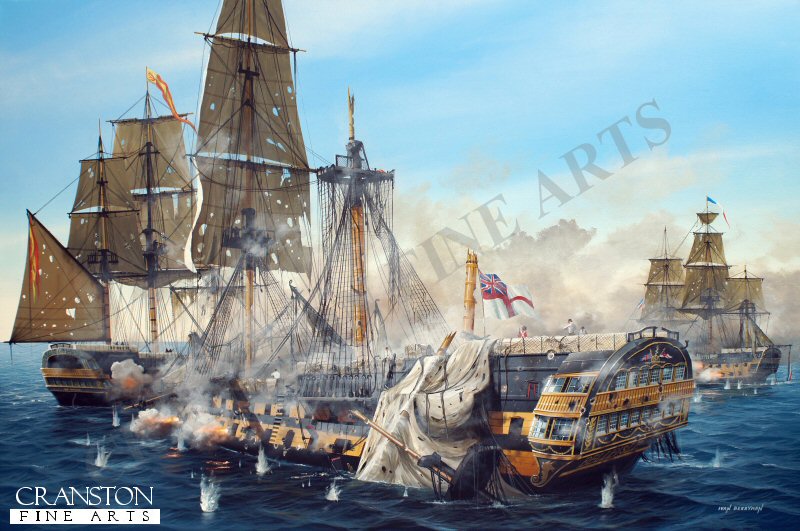
The Battle of Trafalgar - The First Engagement by Ivan Berryman. Midday, 21st October 1805, and Admiral Collingwoods flagship, the 100-gun HMS Royal Sovereign, breaks the allied line and delivers a shattering broadside on the Spanish flagship Santa Ana. Making great speed, Collingwoods ship had breached the Franco-Spanish line some distance ahead of the rest of his van and the Royal Sovereign suffered heavily as she quickly drew the attentions of three French and three Spanish ships. To her starboard, the French Indomitable can be seen firing into the British flagship while, astern of the Santa Ana, Belleisle and Fougueux are engaging ahead of Mars, Monarca and Pluton. |
The Fighting Temeraire by Ivan Berryman. Few ships availed themselves better at the Battle of Trafalgar on 21st October 1805 than HMS Temeraire. Here, she is depicted engaging the French Fougeuex, the two ships inflicting the most terrible damage upon one another in the early stages of the battle. Some crew members can be seen on Temeraire’s foredeck, trying to cut away the fallen fore yard and sail while her fore topsail flaps helplessly above after being set on fire. The acrid gun smoke soon became so bad that Captain Harvey ordered the Temeraire’s larboard guns to stop firing briefly so that he could check that he was not firing on his own ships. Temeraire would eventually take both the Fougeuex and The Redoutable as prizes, at one point having one enemy ship lashed to each side of her hull. As an aside, Temeraire was most likely the only ship at Trafalgar to have no figurehead. Having been built during a more austere period, she lacked much of the decoration of her contemporaries. It is believed, however, that her crew funded a figurehead after the battle from their own prize money, as a ship with no figurehead was considered a ship with no eyes and no soul. A modest crowned head featured at her bow until she was broken up at Beatson’s Yard in Rotherhithe between 1838 and 1839. |
The Tenacious Belleisle by Ivan Berryman. Few ships fought more bravely than HMS Belleisle at the Battle of Trafalgar. Having been second in the line of Collingwood’s leeward division, the 74-gun Belleisle took on a number of opponents including the Monarca, Santa Ana and Indomtable, but soon found herself surrounded by enemy ships that poured weighty broadsides into her. By 2.30 in the afternoon, Bellisle was little more than a floating wreck, having lost all of her masts and bowsprit, yet still she fought bravely on, her colours flying defiantly from the stump of her mizzen mast. Belleisle survived her ordeal and was towed to Gibraltar after the battle where temporary repairs were made, arriving in Plymouth for a refit on 5th December 1805. |
Neptune Engaged at the Battle of Trafalgar by F Sartorious. HMS Neptune is shown attacking the 130 gun Spanish ship Santisima Trinidad, and pounds it relentlessly into a floating wreck. All ships in the painting from left to right : Victory, Redoutable, Temeraire, Fogeux, Santissima Trinidad and Neptune are battling in the foreground, Bucentaure, Conqueror, Royal Sovereign and Santa Anna. |
The Battle of Trafalgar by John Christian Schetky (PC) Nelsons fleet, comprising 27 ships, faced 33 enemy vessels but employed innovative tactics that included breaking the enemy line, allowing his forces to engage the enemy at close range. Not a single British vessel was lost that day, with the enemy having 1 ship sink and 17 captured. The victory at Trafalgar ensured that Britain would remain a dominant maritime power and thwarted Napoleons plans to invade England. |
The Battle of Trafalgar, 21st October 1805 by Ivan Berryman. One of the most decisive battles in the history of the Royal Navy, Nelsons defeat of the French fleet took place on 21st October 1805 off Cape Trafalgar and was conducted with not a single British ship lost, although few ships escaped severe punishment and loss of life on both sides was tragically high |
Trafalgar Dawn by Graeme Lothian. First daylight on the 21st October, saw the Royal Navy fleets together at a distance of about 12 miles. The day looked fine, a heavy swell from the west gave warning of an approaching storm. As dawn broke HMS Victory, Nelsons flagship and the rest of the fleet could be found in a shapeless huddle, which soon resolved itself into two divisions. Thus the two fleets prepared themselves for the coming battle which commenced just before noon. |
The Battle of Trafalgar by Robert Taylor. Robert Taylors magnificent painting shows Victory breaking through the enemy line at 1.00pm 21st October 1805. A broadside has crippled Admiral Villeneuves French flagship Bucentaure, seen off Victorys port side, while Nelsons gunners fire a second broadside into the Santisima Trinidad. Just astern, the Temeraire manoeuvres to trap the Redoubtable between herself and Victory, and thus seal her fate. |
HMS Royal Sovereign at the Battle of Trafalgar by Ivan Berryman. Midday, 21st October 1805, and Admiral Collingwoods flagship, the 100-gun HMS Royal Sovereign, breaks the allied line and delivers a shattering broadside on the Spanish flagship Santa Ana. Making great speed, Collingwoods ship had breached the Franco-Spanish line some distance ahead of the rest of his van and the Royal Sovereign suffered heavily as she quickly drew the attentions of three French and three Spanish ships. To her starboard, the French Indomitable can be seen firing into the British flagship while, astern of the Santa Ana, Belleisle and Fougueux are engaging ahead of Mars, Monarca and Pluton. |
The Battle of Trafalgar Fall of Nelson by Dennis Dighton. Showing the scene onboard HMS Victory as Admiral Nelson is shot by a French marksman in the rigging. |
Battle of Trafalgar by Thomas Whitcombe. No text for this item |
The Battle of Trafalgar, 2.30pm. The Taking of the Santisima Trinidad by Ivan Berryman Dominating the centre foreground, the wreck of the largest ship at Trafalgar, the massive four decker Santisima Trinidad (130 guns), comes under further attack from the British Neptune (98 guns) All her masts have fallen, rendering the Spanish giant an unmanageable hulk. Elsewhere, the battle rages on with Temeraire and Victory engaged with the French Redoubtable, while to the right of the picture, the shattered, drifting remains of Villeneuves Bucentaure (80 guns) is approached by the Mars (74 guns) Conqueror (74 guns), off the Santisima Trinidads port quarter, is keeping up a distant fire to assist the Neptune. |
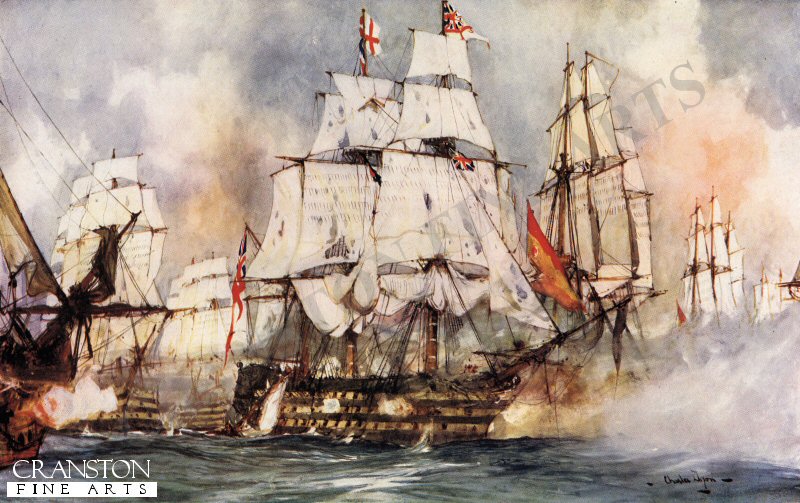
The Victory at Trafalgar. Nelson's Flagship Nearing the Santissima Trinidad by Charles Dixon. Published in 1901 by George Newnes Ltd, this is an original book plate from a large format naval book. These may have some text from the book on the rear of the book plate, but this does not detract from the framed image. Only a few of these original book plates are still available today, more than a century after they were first published. |
Taking of Duguay Trouin (Implacable) After Trafalgar, 1805 by Charles Dixon. Published in 1901 by George Newnes Ltd, this is an original book plate from a large format naval book. These may have some text from the book on the rear of the book plate, but this does not detract from the framed image. Only a few of these original book plates are still available today, more than a century after they were first published. |
| Navigation | |
| Page 3 of 4 | Previous .. Page 3 .. Next |
|
Contact Details |
|
Sign Up To Our Newsletter!
This website is owned by Cranston Fine Arts. Torwood House, Torwoodhill Road, Rhu, Helensburgh, Scotland, G848LE Contact: Tel: (+44) (0) 1436 820269. Email: cranstonorders -at- outlook.com
|
|
|